
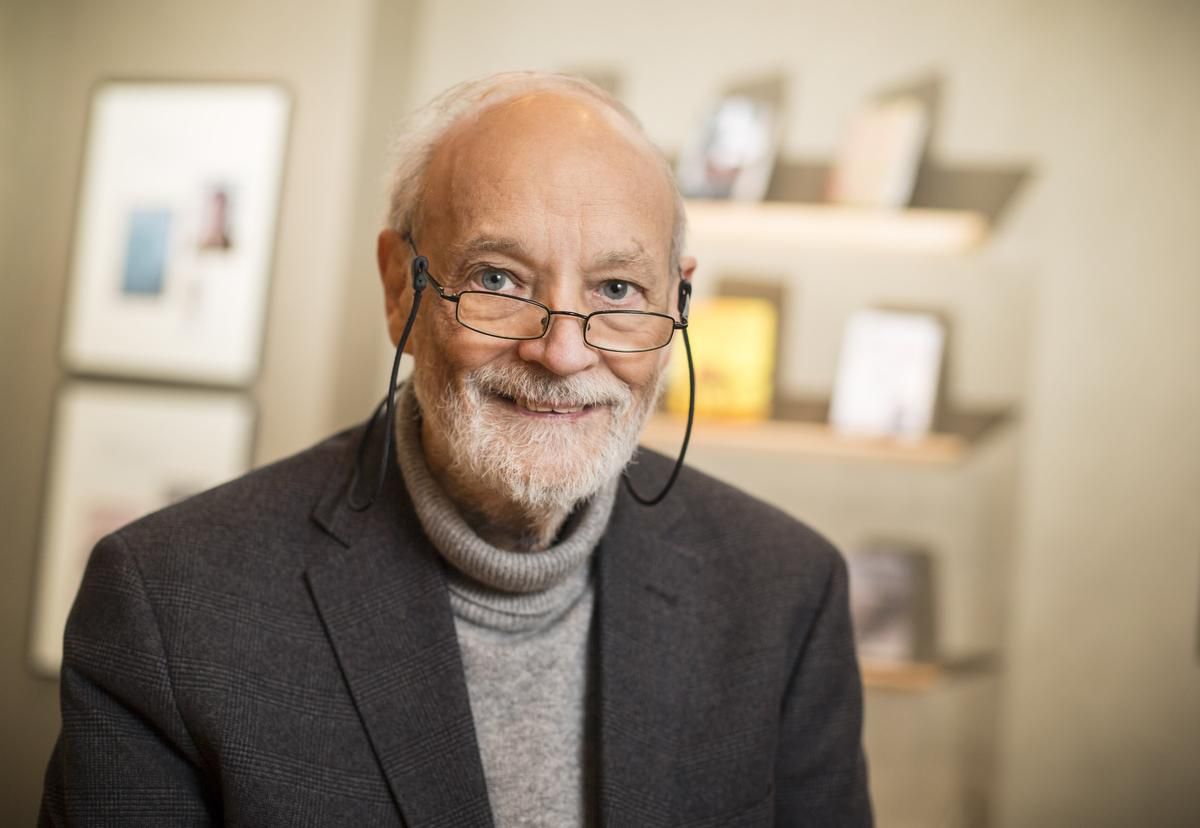

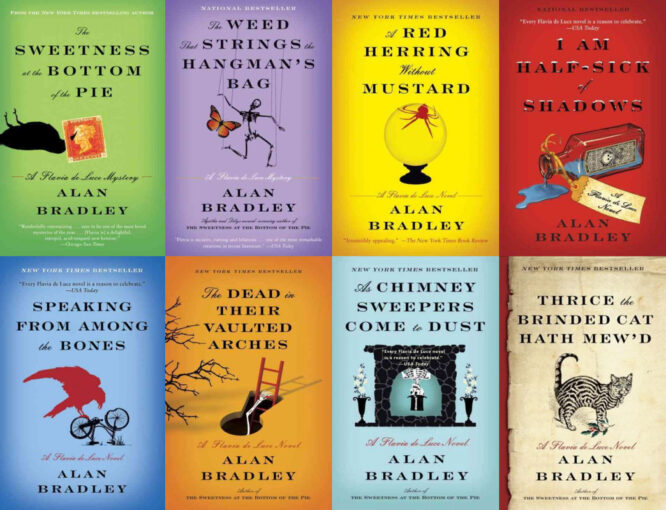
Alan Bradley, after working for many years on the technical side of television, established a strong place for himself in the literary world with the Flavia series, which he began writing during retirement. The first book in the series actually started as a 15-page short story in 2007; when Bradley’s wife suggested he submit it to the Debut Dagger competition, the work won first prize and soon evolved into a novel. Published in 2009, this first Flavia novel introduced literature to a detective character who stood out with her intelligence at a very young age.
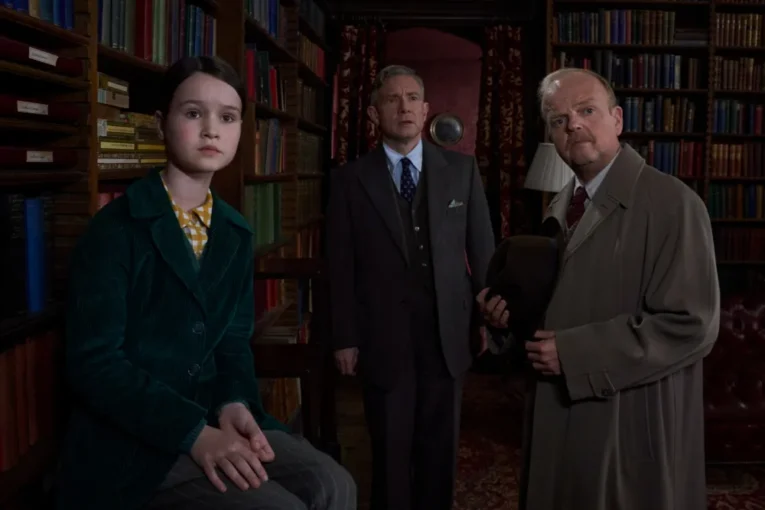
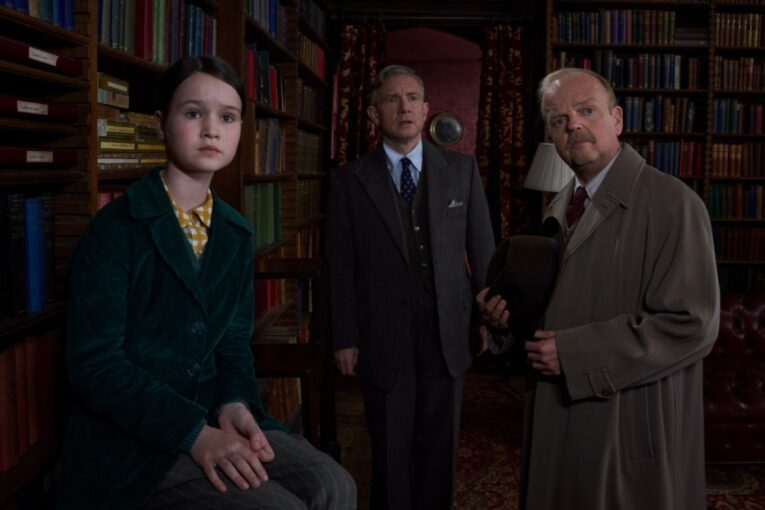
The Flavia series is set in post–World War II England. In the first novel, 11-year-old Flavia’s loneliness, her relationships with her family, her growing pains, her curiosity, and her passion for natural sciences intertwine with themes ranging from postage stamps and mythology to chemistry. Bradley has written 11 novels in the Flavia series, and the first book was recently adapted into a film. The film stars Martin Freeman, Jonathan Pryce, Toby Jones, Meera Syal, and Isla Gie. The screenplay was written by Susan Coyne, and the director is Bharat Nalluri. We spoke with Alan Bradley about the Flavia series.
As far as I know, you worked in television for many years and only started writing stories and scripts after retiring, am I right?
Yes. I worked in the technical end of television and published occasional articles, but didn’t begin a novel until I was retired. A novel is a major commitment of time and attention and is not easily shared with a full-time job.
As far as I know, the first Flavia novel actually began as a 15-page short story and your wife advised you to submit it to the Debut Dagger competition in 2007, where it won first prize. Then within a year, you turned it into a full novel, and the first book was published in 2009. What kind of child was Flavia in your mind when she first came to you all those years ago?
Flavia was a complete stranger who wandered into the pages of another novel I was attempting. She attracted me by her differentness: she was unlike any character I could ever have created. My wife once referred to her as “A gift from the universe” and I think she was right.
There are so many elements in the Flavia series that have really impressed me, and I’d love to ask you about them each. First of all, of course, there’s Flavia herself. She lost her mother when she was just one year old, and in the early books, she doesn’t have the warmest relationship with her two older sisters. She is going through the struggles of growing up, and she’s a very careful and an intelligent girl. And definitely very talkative. She is the main character of a detective series, she’s the one solving mysteries but she’s an emotional and a bit lonely girl discovering more about herself and her family with each book. She’s such a rich character for a detective series, but also a risky choice, since she’s not an adult. How did you navigate those risks when creating her?
Although it’s now commonplace to say that young sleuths or the elderly are invisible, I realized early on that an 11 year old girl is especially so. But she had to be treated with respect. It would be wrong of me to try to impose any of my own thoughts or ideas on Flavia: what I needed to do was sharpen my pencil, shut up, and listen. I became kind of a flawed recording device. But because of my receptiveness, Flavia talks to me 24 hours a day, knowing that she is being listened to and respected.
The Flavia books take place in England, right after World War II, in the year 1950. What made you choose this particular period?
I suppose because I was about Flavia’s age in 1950, I knew how an eleven year old thought. I had read widely for many years about England, from Victorian times up until the present. Flavia’s world is the England of my imagination. I don’t know if it ever existed, but I like to think it did. I hope my characters are happy in the world that Flavia and I have created for them.
I was very surprised to learn that before writing the first story, you actually had never been to England. And yet, you describe the house, the village, the natural beauty, and the people in such vivid details. It must have taken some serious research. What kind of geographical and historical research did you do about England?
A lot of my “research” was done by growing up in Canada in a family of British expats, who were never too ashamed to refer to themselves as “proud Englishmen”. My grandmother’s house was full of British books, and I read widely, from fairy tales to travel, from crumpets to Cornish mythology; from ecclesiastical architecture to natural history. Newspapers, too, and magazines. I spent many a rainy day poring (no pun intended) over long-outdated copies of Country Life and Lilliput, and yes, The Strand Magazine (in bound volumes).
Alan Bradley: “I have always chosen subjects that interest -or have interested- me. To spend a year working on a book requires that you not tire of the matter. I’ve had many enthusiasms in my lifetime, and have used just a few of them in the Flavia books. These are always great fun to research, and to find out facts that you have missed in the past, as well as catching up on current developments. Fortunately, Flavia’s world is frozen in time, and I don’t have to research anything after the early 1950’s.”
When I read the first book in the series, I assumed you had a deep admiration for chemistry, that it was a long-standing passion of yours. And I believe many readers think the same. But in fact, you didn’t have a chemistry background, and you learned all those details because of Flavia, am I right?
I know little of chemistry. In high-school, I had a homeroom teacher whose teaching field was chemistry, but I was never comfortable with it. I didn’t like the stinks and bangs. I still remember with horror the practical jokers who set aflame the gas jets in the Science lab. Electronics seemed to hold much more romance. How wrong I was!
In every book of the series, you manage to surprise your readers. Each story has a subject that Flavia has to investigate, topics that require serious expertise. The history of postage stamps, puppetry, mystical beliefs, the history of graveyards and churches, religious arts, medieval manuscripts, aviation history, toxicology… You explore each of these themes with such depth that while we’re reading an engaging, fast-paced novel, we also find ourselves drawn into these different topics. How do you choose these themes, and what kind of preparation and research do you do beforehand to write about them in such detail?
I have always chosen subjects that interest -or have interested- me. To spend a year working on a book requires that you not tire of the matter. I’ve had many enthusiasms in my lifetime, and have used just a few of them in the Flavia books. These are always great fun to research, and to find out facts that you have missed in the past, as well as catching up on current developments. Fortunately, Flavia’s world is frozen in time, and I don’t have to research anything after the early 1950’s.
As a child, Flavia investigates crimes happening in her village, or sometimes even in her own backyard. But as the series progresses, she also begins to uncover the secrets and history of her own family. For example, she eventually learns that her mother was a spy. So while your novels follow the traditional structure of a Golden Age detective story, they also blend with subgenres like spy fiction and historical fiction, which adds even more richness to the series. Would you agree?
I have not intentionally touched upon other genres, but feel strongly that the storylines be interesting and the characters real. If, in passing, they happen upon real romance or horror, real suspense or adventure, that simply adds to the richness of their lives, and brings them more to life. It is always rewarding when a minor character develops a sudden and unexpected depth: you can see them coming to life, and you feel somewhat what Dr. Frankenstein must have felt. Which must have been pride and a kind of love.
Flavia and Dogger’s relationship is one that moves me deeply every time I read about it. I feel like you’ve written their connection with such sincerity and it’s very different. Or maybe I just feel that way because I love them both so much. What does their relationship represent for you?
Their relationship moves me, too. I always feel privileged to sit on the sidelines listening to Flavia and Dogger talk. There is always a hush that comes over things as I write these scenes. I am especially aware of the need to remain totally silent, and to record faithfully what they say to one another. I must not, in even the slightest way, intrude upon their privacy. I must not, under any circumstances, try to insert anything of Alan Bradley into their conversations. It’s like being a court reporter: silent but deadly accurate, and above all, respectful.
The first book in the Flavia series is being adapted into a film. The cast has already created a lot of excitement. How does it feel to have your novel turned into a movie? Could you share the latest updates about the film with us? When can we expect to watch it, and what are your own expectations for the adaptation?
I don’t yet have a release date, although I understand that the film is now complete. I was privileged to be invited to several of the filming locations last October, and what I saw far exceeded my expectations. The film was in the hands of people who love Flavia as much as I do, and every aspect of it left me in awe. I can hardly wait!
Also, I would like for your Turkish readers to know about another side of your work. You’re actually a devoted reader of detective fiction, and many years ago, you even wrote a nonfiction book called Ms. Holmes of Baker Street: The Truth About Sherlock. When and how did your interest in Sherlock Holmes, and detective fiction begin?
I’ve mentioned my growing up in an expat British household, and it was here that the Sherlock Holmes books were put into my eager hands by an uncle. I remember distinctly being intrigued when he mentioned that Sherlock had an older brother who was too lazy to leave home to investigate. The quirkiness of that caught my interest. It was tantalizing. And then, of course, to become immersed in Conan Doyle’s rich prose style. I still think he isn’t given enough credit.
When will the 12th book in the Flavia series be released? And what are your upcoming plans for the book series?
I have just in the last week completed the 12th Flavia book, “Numb Were the Beadsman’s Fingers.” It’s too early to have a publication date, but I expect it to be early next year. In a couple of months I’ll be 87, and I think it’s time to put my feet up for a while and leaf lovingly through some long-outdated copies of Country Life, Lilliput, and yes, perhaps the Strand Magazine.
As we approach the end of the first 25 years of the new millennium, I’ve been keeping track of the detective novels and series I’ve truly loved and found original. For me, the Flavia series is undoubtedly one of the best and most distinctive detective series written in this century. In your opinion, what are some of the best and most original mystery novels of the past 25 years?
Oh, my goodness. That’s the toughest question so far. I haven’t had much of a chance to read in the past few years, but I’d certainly have to mention Peter Lovesey. I still remember where I was standing when I picked up a copy of his “Wobble to Death” in 1970. It was seldom I’d found a book so immersive and so rich in ambience (although I hate that word) I became a fan and remain one. One of the greatest highlights of my writing career was to spend a summer afternoon sitting in a Shropshire garden with Peter and his wife.
Other books that have lifted my heart have been Thomas King’s Thumps DreadfulWater novels. Unique, funny and heartbreaking.
Louise Penny’s Inspector Gamache novels have become legendary. I will never forget my gasps upon reading her “Still Life”. In more recent years, Louise has been a great Flavia supporter, and her kind words have left me sometimes speechless.
Tony Hillerman’s Navajo mysteries and James Lee Burke’s Dave Robicheaux novels are solid gold.
Aside from these treasures, much of my limited reading has been outside the mystery genre, and I can never commend too highly Patrick O’Brian’s Jack Aubrey novels and George Macdonald Fraser’s Flashman novels.
This interview was conducted by Özlem Özdemir and originally appeared in 221B Magazine’s MIPCOM 2025 issue.