
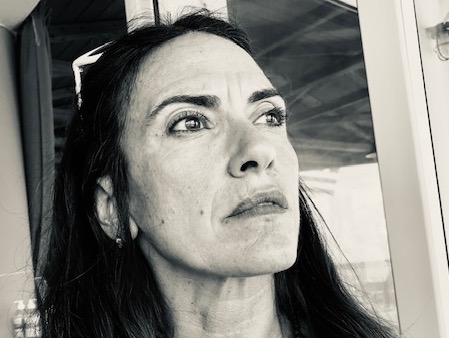
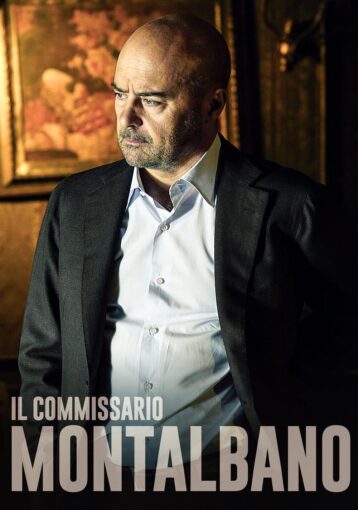
Andrea Camilleri is widely recognized as one of the founding voices of Mediterranean noir, and for many years, Valentina Alferj worked at his side as his literary agent and closest creative collaborator. Together, they brought Il Commissario Montalbano from page to screen, shaping one of Europe’s most enduring and beloved crime series (1999-2021), which still captivates audiences worldwide. More recently, Valentina Alferj has extended this Mediterranean legacy by writing the screenplay for Kostas, adapted from the acclaimed novels of Petros Markaris, one of the most prominent living masters of the genre. Produced by Palomar and Rai Fiction, the series stands out as one of the most recent examples of Mediterranean noir. In this conversation, Valentina Alferj reflects on her collaboration with Camilleri, the enduring appeal of Mediterranean crime fiction, and the growing intersection between literature and screen adaptations in Italy and beyond.
You run a literary agency in Italy and you’ve worked closely with Andrea Camilleri for many years. Together, you also collaborated on the television adaptation of his novels, Il Commissario Montalbano, a cult series that aired between 1999 and 2021. During the period when the Montalbano novels were being adapted for the screen, what was your working process like? How did the creative and production journey unfold?
Valentina Alferj: The work on the television adaptation of Montalbano stems precisely from my work alongside Camilleri for many years. In his later years, when he had lost his sight, our work became much deeper and more detailed. No longer able to write, Camilleri relied completely on me to draft and supervise his work. The work process therefore, consisted of reading the scripts with the actors and the director, which allowed us to understand whether the adaptation respected the key points of Camilleri’s writing. Camilleri always gave the fiction team a lot of freedom, because he knew from experience as a director, how much difference there is between writing a novel and rendering it in images. He also trusted his producer and the whole team very much. My work also consisted of revising the dialogues, which were a fundamental part of the fiction precisely because of Camilleri’s invented language, a mixture of various Sicilian dialects.
Do you think we might see Commissario Montalbano adapted again in the future? Is it something being considered, or something you personally think could be possible?
Valentina Alferj: I believe it is entirely possible to imagine a new life for Inspector Montalbano, and I hope that producer Carlo Degli Esposti will make it happen so as soon as possible. The series of novels about the Inspector lends itself to many different interpretations. The Young Montalbano series already offered a different interpretation from the traditional one. For example, I imagine it to be much more of a thriller and much darker. I would emphasize the Sicilian aspect in its grey tones, and I see a Montalbano who is much less resolute than the one we are used to seeing on TV. This does not mean that I do not like it, quite the contrary. After 30 years, I am always happy when I find a rerun on television.
You also wrote the screenplay for Kostas, adapted from the acclaimed crime novel series by Petros Markaris, one of the founding voices of Mediterranean crime fiction. How did the process of bringing Kostas to life begin, and how did it evolve?
Valentina Alferj: Thanks to my work with Camilleri, I was able to meet Petros Markaris. Our friendship continued even after Camilleri’s death. Being a great reader and admirer of his work, when I had the chance, I talked about it to Carlo Degli Esposti di Palomar, and together with the production team and the great director Milena Cocozza, we developed the project and then shot the series in Athens.
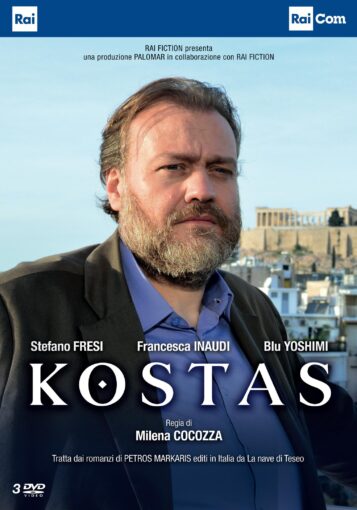
With Kostas, produced by Palomar and Rai Fiction, it wasn’t an Italian crime novelist being adapted, but Petros Markaris’s series. I believe Mediterranean noir brings together stories and characters that can appeal to readers and viewers across many countries. As someone who knows these projects from the inside and as a literary professional, do you think we’ll continue to see more adaptations of crime novels from different countries in Italy, as happened with Kostas? Or is this already happening today?
Valentina Alferj: I don’t know if they are developing new foreign series in Italy. Certainly, in Italy, we have the largest possible number of crime writers. This is for various reasons, the first being Italian regions so deeply different that a detective from Turin is so far removed from a police inspector from Puglia, telling and living such different stories that it seems as if they are from distant countries. In the case of Kostas, filmed in Athens but with Italian actors, it didn’t feel like filming a foreign series; rather, we found so many similarities with Italian culture and society that there have never been any misunderstandings.
Valentina Alferj: There is always a very strong interest in fictional stories, perhaps with female protagonists, but it seems to me that there is very little courage and that things proceed in ‘waves’. There is a trend for autofiction, family sagas, and, of course, crime stories, which are always in high demand.
You are also the founder of an agency that represents many important authors and their books. So I’d like to explore the subject of adaptations in a bit more detail with you. In Italy, in recent years, what proportion of films or series have been based on novels?
Valentina Alferj: It is difficult to understand how the audiovisual market is evolving. After the COVID and post-COVID bubble, all producers were optioning rights to novels, but it now seems to me that things have quietened down. There is always a very strong interest in fictional stories, perhaps with female protagonists, but it seems to me that there is very little courage and that things proceed in ‘waves’. There is a trend for autofiction, family sagas, and, of course, crime stories, which are always in high demand. I would say that at the moment, many mini-series are being developed and few films. Furthermore, in Italy, there is a big difference between Rai products and those for platforms, a gap that seems to me to be increasingly evident.
How closely do the film, TV, and streaming industries work with the publishing world in Italy? As agencies, do you collaborate directly with producers on adaptations, perhaps even making suggestions?
Valentina Alferj: No, we don’t collaborate directly, but we are in constant contact. Lorenza Ventrone, who handles adaptation rights for our agency, often finds herself suggesting or listening to ideas that arise from our literary experience in comparison with the demands of the audiovisual market.
Crime fiction is on the rise worldwide, with dozens of new series produced every year for TV channels and streaming platforms, and many of them based on novels. This is an exciting development, but do you think it also affects crime writers as they create their books? For example, could it be said that more novels are now being written with potential screen adaptations in mind, sometimes at the expense of originality? As both a screenwriter and a literary agent, what are your observations?
Valentina Alferj: I believe the difference lies upstream. There are writers who write their novels with only reading and literature as their reference point. There are writers who already have the idea or proposal to turn that text into a screenplay. Often, the two things cannot coexist at the same level of quality. In fact, there are many writers who have decided to prioritize the television version of their novel, and often this decision can lead to less originality or attention to the quality of the writing. These are decisions.
Valentina Alferj: At the agency, I work with Antonio Manzini, who is one of the few Italian writers who manages to keep the writing of his novels and the screenplay of his Rocco Schiavone television series distinct, separate, and both of excellent quality. Thanks in part to his past as a screenwriter, he has managed to create two different products of the highest quality. It is no coincidence that Rocco Schiavone’s books are among the best-selling in Italy, just as the series is the most loved in Italy and abroad.
This exclusive interview was featured in 221B Magazine’s MIPCOM 2025 issue.